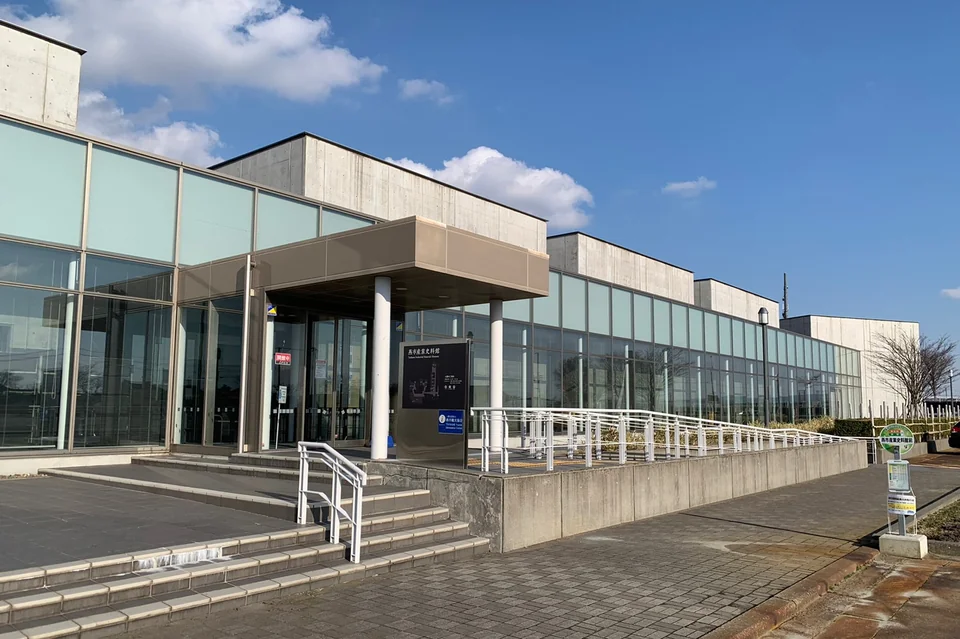
Discover how Japanese nails became part of a much broader metalworking story at Tsubame Industrial Museum. Its displays trace about 400 years of local craft, while optional hands-on activities offer another way to explore the subject.
Featured image: Tsubame Industrial Materials Museum Mar2022-001.jpg — Drph17 / Wikimedia Commons. CC BY 4.0. Resized and converted to WebP. Image source · CC BY 4.0 — https://creativecommons.org/licenses/by/4.0/
Why visit
The appeal is the connection between finished objects and the work behind them. Displays follow Tsubame metalworking from Edo-period Japanese nails through hammered copperware, pipes and engraving to contemporary metalworkers. Reconstructed workspaces and production-process displays help make this more than a collection of beautiful objects: consider looking for how tools and techniques shape what you see.
Plan your visit
Decide whether you want an exhibition visit or would also like to try a hands-on activity. Ordinary admission is JPY 400 for adults and JPY 100 for elementary, junior-high and high-school students; activities cost extra.
For the local approach from Tsubame-Sanjo Station, the operator estimates about five minutes by taxi. Its shortest walking-route estimate is about 2.4 km, or 33 minutes at 80 metres per minute, and it recommends a car or taxi for the distance. Choose your approach with that walk in mind rather than treating the museum as a station-side stop.
Make the most of your visit
Try using the reconstructed workspaces to connect the historical displays with the production processes. Rather than rushing from object to object, consider choosing one craft, such as hammered copperware or engraving, as a thread through your visit.
Request an English audio guide at admission if you would like spoken interpretation; Japanese and Chinese guides are also offered. If a hands-on activity interests you, leave room for it alongside the displays rather than making it the sole reason to visit.
Planning notes
Information checked on 2026-10-12: opening hours are 09:00–16:30. Hands-on workshop reception ends at 16:00; this is not a separately confirmed final museum admission time.
The museum closes Mondays, with a next-day or next-weekday closure when Monday is a public holiday, and from 29 December to 3 January. Consult the current calendar rather than assuming every holiday opens.
Audio-guide stock is limited to 30 devices. Group visits require advance application, and workshop rooms can be privately booked; activities and devices are not guaranteed for a particular day. Room-hire charges are separate from ordinary admission. The address is 4330-1 Omagari, Tsubame; the station approach estimates above describe local access, not a complete journey from Tokyo.
Practical information
Highlights
History and highlights: Displays trace about 400 years of Tsubame metalworking, from Edo-period Japanese nails to hammered copperware, pipes, engraving and contemporary metalworkers. The museum includes reconstructed workspaces and production-process displays.
Information as of .
Opening hours
Open 09:00–16:30. Hands-on workshop reception ends at 16:00; this is the workshop cutoff, not a separately confirmed final museum admission time.
Information as of .
Price
Ordinary admission: adults JPY 400; elementary, junior-high and high-school students JPY 100. Hands-on activities have separate fees. Room-hire charges are not ordinary admission prices.
Information as of .
Closures and restrictions
Closed Mondays, with a next-day / next-weekday closure when Monday is a public holiday, and 29 December–3 January. Consult the current calendar; do not infer every holiday opens.
Information as of .
Access
Location and access: 4330-1 Omagari, Tsubame. Tsubame-Sanjo Station taxi is about five minutes. The operator estimates the shortest walking route at about 2.4 km / 33 minutes at 80 metres per minute and recommends car or taxi for the distance. These are local estimates, not a full Tokyo journey.
Information as of .
Reservations
English, Japanese and Chinese audio guides are available to request at admission, with a limited stock of 30 devices. Group visits require advance application. Workshop rooms can be privately booked; activity and device availability are not guaranteed for a particular day.
Information as of .
Useful links
Tsubame Industrial Museum visitor information
Information based on checks dated 2026-10-12.