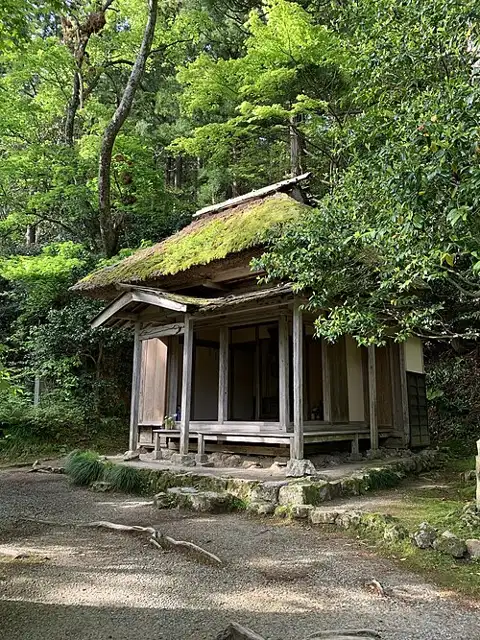
Gogoan offers a small-scale encounter with literary history: a woodland hermitage on Mount Kugami associated with the poet-monk Ryokan. Come for the modest building and its setting among trees near Kokujouji Temple, rather than expecting a tour inside.
Featured image: Tail furry / Wikimedia Commons Original photograph · CC BY-SA 4.0 · Photographed 6 May 2021; resized and converted to WebP. Historical photograph; no interior entry is implied.
Why visit
According to Tsubame City, Ryokan lived at Gogoan from 1804 to 1816. That connection gives the small hermitage its particular appeal: it is a place to consider the poet-monk through the scale and surroundings of his former home. Its name has an earlier story, referring to the five go of rice supplied daily to a previous resident, the monk Bangen.
Plan your visit
The temple recommends coming by car, with rental cars near Tsubame-Sanjo Station or a taxi from Yoshida or Yahiko stations as suggested options. Use the Visitor Service Center parking, rather than parking along the temple approach.
For a broader walk, the temple FAQ describes a circuit from the center via the main hall, lecture hall, Gogoan and Sengando Suspension Bridge, returning to the center. Its stated time is about 30 minutes; allow extra time for stops rather than treating that as a fixed visit length.
Make the most of your visit
Try giving the hermitage itself your attention before moving on: its modest proportions and woodland setting are the focus here. Consider holding Ryokan’s years of residence in mind as you look at the building and surrounding trees. This keeps the stop centered on literary heritage, rather than making it simply another point on the temple circuit.
Planning notes
Check local weather and on-site signs before taking the wooded paths. Treat this as an outdoor literary-heritage visit; the described circuit does not imply a step-free route, entry to the hut or a hosted activity.
Practical information
History
History: Gogoan is the hermitage associated with the poet-monk Ryokan, who lived here from 1804 to 1816 according to Tsubame City. The name refers to five go of rice supplied daily to an earlier resident, the monk Bangen.
Information as of .
Highlights
Highlights: The small hermitage lies on Mount Kugami among trees near Kokujouji Temple. Its modest scale and woodland setting are the focus of this literary-heritage visit. This does not promise entry to the hut or a hosted activity.
Information as of .
Access
Access: Use the Visitor Service Center parking for Gogoan, Kokujouji, Asahiyama Viewpoint and Sengando Suspension Bridge. The temple FAQ describes a circuit via the main hall, lecture hall, Gogoan and bridge back to the center as about 30 minutes; allow extra time for stops. This is not a verified accessible route.
Information as of .
Access
Access: The temple recommends a car for the area: rental cars near Tsubame-Sanjo Station, or a taxi from Yoshida or Yahiko stations. Ordinary parking is at the visitor center, not along the temple approach. Check local weather and signs for the wooded paths.
Information as of .
Useful links
Tsubame City: Ryokan heritage sites
Kokujouji official visitor guide
Information based on checks dated 2026-10-22.