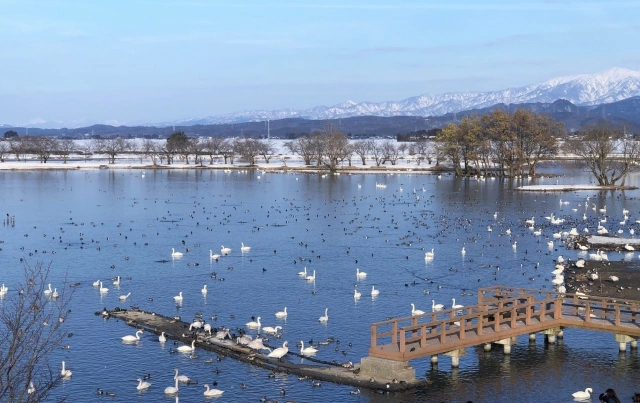
Wintering swans give Hyoko Lake its seasonal appeal, while the surrounding ponds and walking paths offer a waterside setting for birdwatching. For a swan-focused visit, choose early morning or evening rather than midday, when many birds leave for nearby rice fields.
Featured image: うるうるあ / PhotoAC (25202627). Converted to WebP. Image source PhotoAC standard licence
This winter photograph illustrates the setting, not current bird numbers or snow conditions.
Why visit
Hyoko is a Ramsar-listed wetland known for wintering swans. Its appeal combines the chance to watch these seasonal visitors with a walk through Hyoko Waterfowl Park, which preserves the main lake and includes surrounding ponds, an observation shelter and birdwatching paths. Consider it for a visit centered on waterbirds and the lakeside landscape.
Plan your visit
Let your main interest guide the season and time of day. The city describes the first swan arrivals in early October and their stay through March. Early morning or evening is recommended for watching them: many swans spend the daytime in surrounding rice fields, making midday a less promising choice for a swan-focused outing.
For flowers instead, the city's seasonal guide describes cherries in April–May, irises in June, and lotus and other summer flowers in July–August.
Make the most of your visit
Try using the observation shelter as a place to watch the waterbirds, then explore the walking paths for a broader look at the main lake and surrounding ponds. Make birdwatching, rather than a target flock size, the focus of your outing; a midday visit may reveal fewer swans, but the park's waterside paths remain part of its appeal.
Planning notes
For navigation, use the park address: 313-1 Suibara, Agano City, Niigata. The park office has a different address and is not the visitor destination. The city lists roughly 350 parking spaces across four parking areas, with parking free; this does not establish an admission price or a public-transport fare.
The supplied city information was checked on 9 October 2026. Swan arrivals, numbers and sightings vary, so neither a flock nor a current count is guaranteed. Flowering also depends on seasonal conditions, and the listed blooms are not promised for an October visit.
Practical information
Seasonal notes
Seasonal highlights: Hyoko is a Ramsar-listed wetland known for wintering swans. The city describes the first arrivals in early October and their stay through March; numbers and sightings vary.
Information as of .
Seasonal notes
Seasonal highlights: Early morning or evening is recommended for swan watching. Many swans leave the lake for surrounding rice fields during the day, so a midday visit may show fewer swans. Do not guarantee a flock or a current count.
Information as of .
Highlights
Highlights: Hyoko Waterfowl Park preserves the main lake, with surrounding ponds, an observation shelter and walking paths for birdwatching.
Information as of .
Seasonal notes
The city describes cherries in April–May, irises in June, and lotus and other summer flowers in July–August. Blooming depends on the season and conditions; none is promised for an October visit.
Information as of .
Access
Park address: 313-1 Suibara, Agano City, Niigata. The park office address differs and is not the visitor destination.
Information as of .
Price
The city lists roughly 350 spaces across four parking areas, with parking free. This is a parking charge statement, not a verified admission or public-transport fare.
Information as of .
Useful links
Information based on checks dated 2026-10-09.
For another wetland guide, explore Fukushimagata’s scenery and visitor centre. Plan each stop separately with current local transport information.